Introducing Decarbonization
Most companies today measure their greenhouse gas emissions. Far fewer know what to do next. Targets are set, reports are filed, and then the hard part begins: understanding which measures to implement, when to implement them, and at what cost.
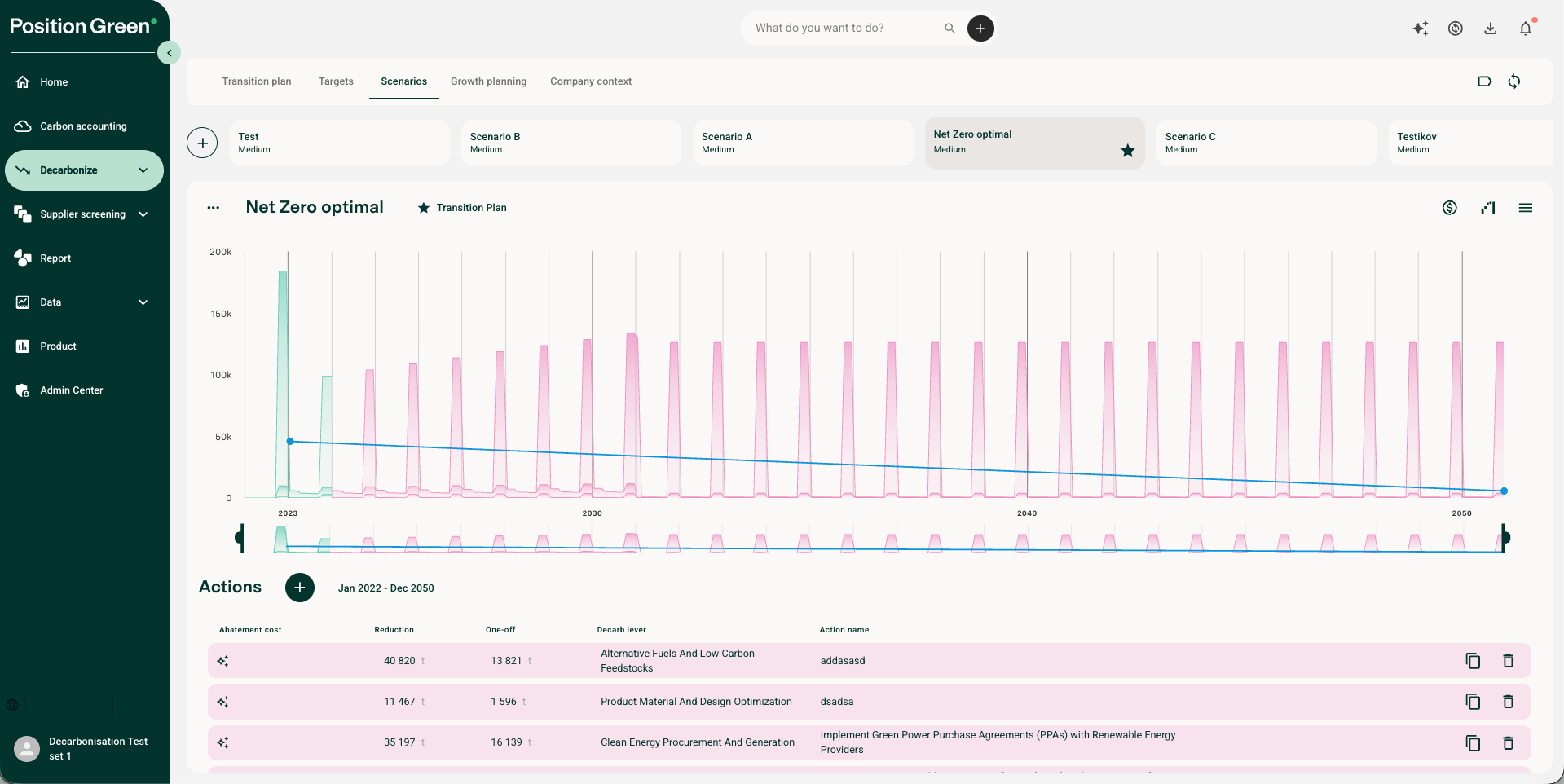
Decarbonization turns high-quality carbon accounting data into a practical plan for reducing emissions over time.
Why this is important
Collecting accurate data is only half the job. To cut emissions, organizations need to:
- See where reductions are realistically possible
- Compare different options and their impact
- Prioritize measures across sites, suppliers, and business units
- Stay on track against short-term and long-term targets
Position Green Decarbonization provides a structured way to move from "This is our footprint" to "These are the concrete steps we will take in the next 1, 3, and 10 years".
How it works
Decarbonization builds on Position Green Carbon Accounting. It uses both activity-based and spend-based emissions data to create a complete overview for the transition plan.
Use Decarbonization to:
- Identify key reduction levers
- See which sites, categories, suppliers, or activities have the biggest reduction potential
- Model scenarios before taking action
- Test measures, such as switching fuels, changing suppliers, retrofitting buildings, or adjusting travel policies, and see their impact on emissions and timelines
- Prioritize measures based on impact and effort
- Compare feasibility and emission reductions to choose the measures that make the most sense for the business
AI-assisted workflows help structure measures, suggest options, and update the plan as new data comes in. The goal is not to replace judgement, but to make informed decisions easier and faster.
For sustainability teams with limited time and resources, this means less time building spreadsheets and more time driving real change in the organization.
Built for busy or understaffed sustainability teams
Creating a transition plan has traditionally been a time-consuming and complex process involving many stakeholders and areas of expertise. Many organizations outsource this work, but this often leaves companies with static reports and limited ownership of the plan or the work needed to realize it.
Position Green Decarbonization is built for teams that want to go further but lack time, resources, or expertise. It is designed for organizations that already have, or are building, a solid carbon accounting foundation and need help turning insights into action.
Typical use cases include:
- Translating a high-level target into a concrete roadmap
- Comparing different technology or supplier choices before investing
- Coordinating decarbonization work across multiple business units
- Showing management clear scenarios and trade-offs in a simple way
- Keeping the full picture in one place instead of scattered across presentations and spreadsheets
Get access to Decarbonization
Decarbonization is an extension of Position Green Next Gen Carbon Accounting.
If the organization already uses Position Green Next Gen Carbon Accounting, Decarbonization connects directly to existing data and configurations.
If the organization is new to Position Green, start by setting up carbon accounting to get full value from Decarbonization.
Was this article helpful?
That’s Great!
Thank you for your feedback
Sorry! We couldn't be helpful
Thank you for your feedback
Feedback sent
We appreciate your effort and will try to fix the article