TABLE OF CONTENTS
In cases where the Reporter must report a series of data, repeatable rows can be used. Where there is no fixed limit to the types of data to be provided, add repeatable rows in the measure builder.
Use repeatable rows when for example, logging social initiatives, raw production data, and material use.


What repeatable rows look like in the survey.
How to add a repeatable row
Drag and drop to add a repeatable row. Add measures in as with any other row.

How to add a repeatable and edit the content.
Delete
This button is only used on a repeatable row to allow reporters to remove a row they have added.

Example: Social initiatives
The number of social initiatives the Reporters have been working on is unknown so we want to allow the Reporter to add a series of initiatives. Add a Repeatable row, add the measures to receive the data we need, and include a delete button.
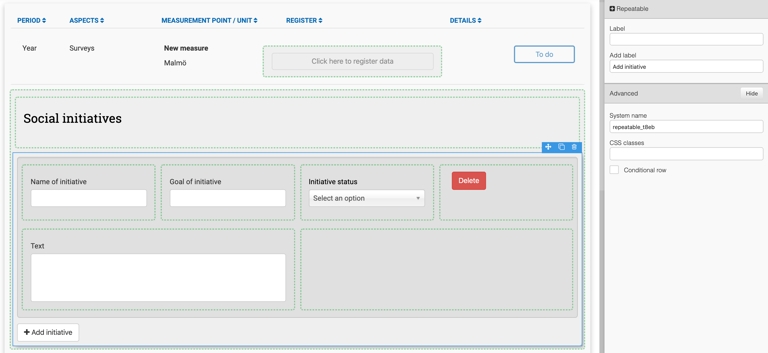
Enable reporting of multiple social initiatives.

Example of repeatable rows in the reporter view.
Advanced
Row identifiers
A row identifier tells Position Green which field in a repeatable is "the same" row — either across reporting periods, or across org units when consolidating data in Group Reporting.
For historical data, it's what lets reporters see and reuse a row's previous answers instead of re-entering them from scratch. Without a row identifier configured, the platform can't match this year's rows to last year's — no historical data will show for that repeatable, even if reporters filled it in previously.
For group reporting, it's what lets rows with the same key value be aggregated into one instead of listed side by side. For example, if a repeatable reports employee data by country across several org units, setting the row identifier on the country field means every org unit reporting "Sweden" consolidates into a single Sweden repeatable row at group level, rather than one row per org unit.
To enable it, mark one or more controls in the repeatable row as row identifiers when building the measure.
Adding the row identifier
Select the repeatable. You should see the repeatable system name formatted as repeatable_XXXX.
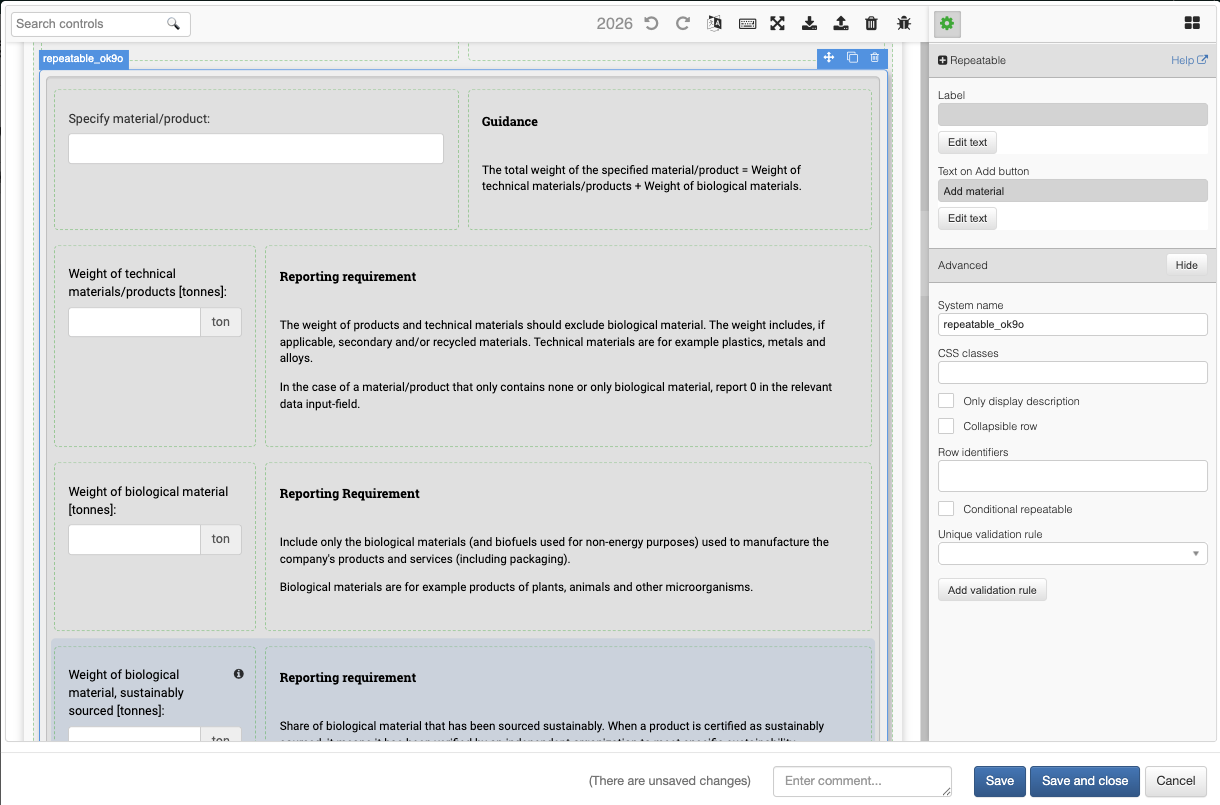
Select the row identifier(s):
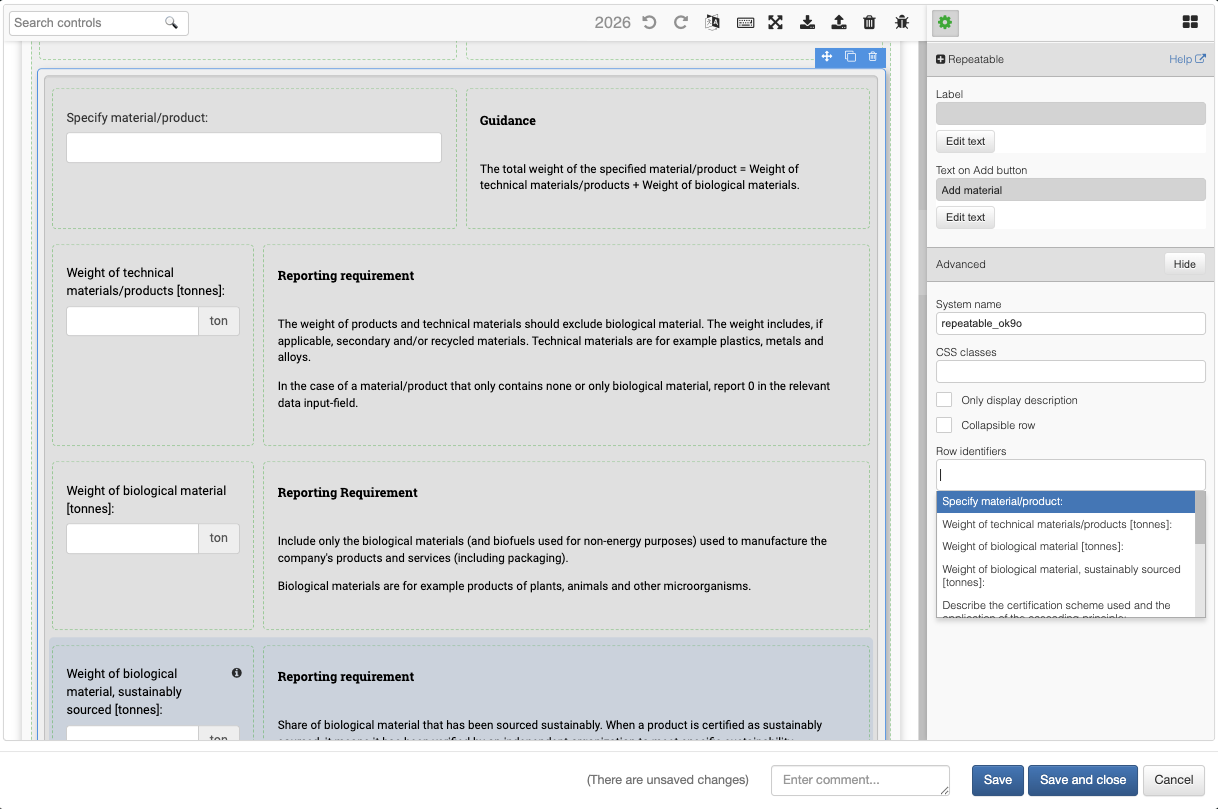
This is set per year, not once for all time
Measures are year-specific, so the row identifier needs to be set on each year's version of the measure — it doesn't carry forward automatically. For historical data functionality, at a minimum, set it on the current period's measure and the previous period's, since that's the pair being matched against each other.
Choosing a good identifier
Pick a field whose value will stay consistent — both period over period, and org unit to org unit if the measure feeds into Group Reporting. Dropdown fields work best, since reporters are selecting from fixed options. If you use a free-text field as the identifier, matching depends on the reporter typing the exact same text each period — "Scope 1 & 2" and "Scope 1 and 2" will be treated as two different rows, and the historical linkage breaks.
What reporters will see
Once configured, reporters will see historical values appear beneath each field in a matched row after they refresh the page. See historical data for the full reporter-facing walkthrough.
Validation rules
Validation rules can be added for the minimum or maximum amount of rows a reporter can add to a survey.
Example: Make it mandatory for reporters to answer at least one repeatable by adding the validation rule (>=1)

Select the entire repeatable row.
 Add validation >=1.
Unique validation
The repeatable row can set a unique constraint for the rows inside the repeatable row, enforcing that the reporter can only select the same value once.
For example, there is only one entry to be made for each type of a certain fuel.

Create a unique validation rule.
Was this article helpful?
That’s Great!
Thank you for your feedback
Sorry! We couldn't be helpful
Thank you for your feedback
Feedback sent
We appreciate your effort and will try to fix the article